




The Senate today voted along party lines to pass its version of the state supplemental operating budget, with opponents arguing it is not sustainable and reduces the percentage of spending that is dedicated to K-12 education.
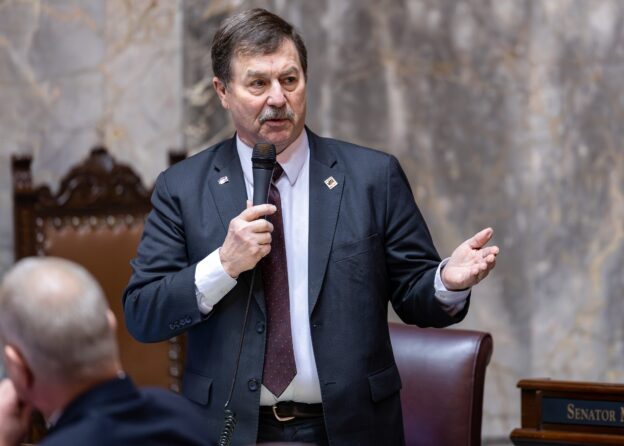
Sen. Mark Schoesler, R-Ritzville, voted against the budget, which was passed on a 30-19 vote.
“The Senate Democrats’ operating budget relies heavily on one-time money,” said Schoesler, who serves the 9th Legislative District. “It would drain the state’s unrestricted reserves by $2.4 billion, take $750 million from the state’s rainy-day fund, transfer $395 million in capital-gains revenue from the capital budget to the operating budget, and raid $375 million from the Public Works Fund. It’s very risky to rely so much on these transfers and raids.”
Schoesler also opposes the Senate’s operating budget proposal because it makes K-12 education less of a spending priority.
“Under this budget, K-12 education funding would drop to just over a 42% share of the budget, which is lower than at the time when the state Supreme Court’s McCleary ruling was issued in 2012 (43.4%). When Republicans controlled the Senate in 2017, the level of K-12 spending in the operating budget was over 50%. It is a real concern to see K-12’s share of the budget pie become smaller, especially when the state constitution says education is supposed to be the paramount duty of our state.”
Schoesler pointed out that nonpartisan staff on the Senate Ways and Means Committee, which oversees the operating budget, told members there was an estimated gap of $1.5 billion for the current budget cycle and $4.3 billion for the four-year budget outlook ending in 2029.
“Instead of incorporating ideas offered by my Republican colleagues to erase this shortfall through savings and efficiencies, and avoid needless new spending, Senate Democrats instead have created a supplemental operating budget that would increase spending by $2.3 billion, which is 53% more than the $1.5 billion budget gap. At a time when we have a real budget problem, we should not jack up spending so much.”
The Senate Democrats’ supplemental operating budget would result in an 11.3% spending increase for the 2025-27 budget cycle compared to 2023-25. If their budget is enacted, it would result in an $80.1 billion budget, more than double the amount of the 2015-17 budget ($38.2 billion) – which was the last budget created under a Republican-controlled Senate.
Once the House of Representatives approves its supplemental operating budget, key legislators from each chamber will meet to work on a compromise budget for the Senate and House to consider.
The 2026 legislative session ends March 12.