






Tag Archives: 2026 Legislature
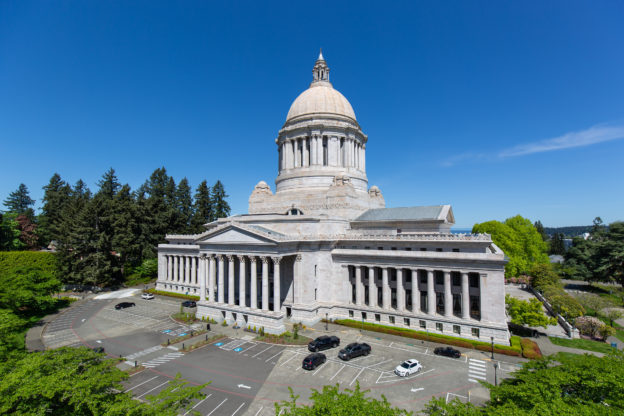
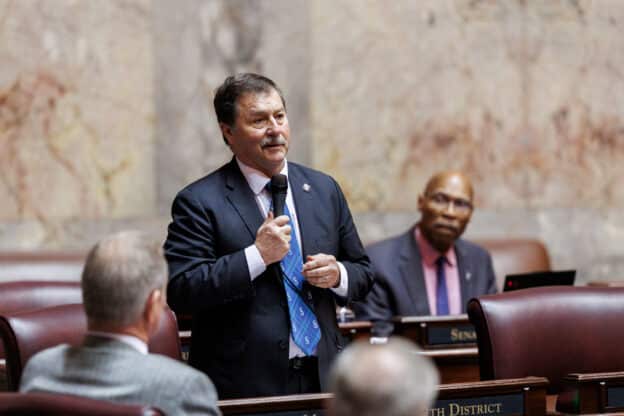
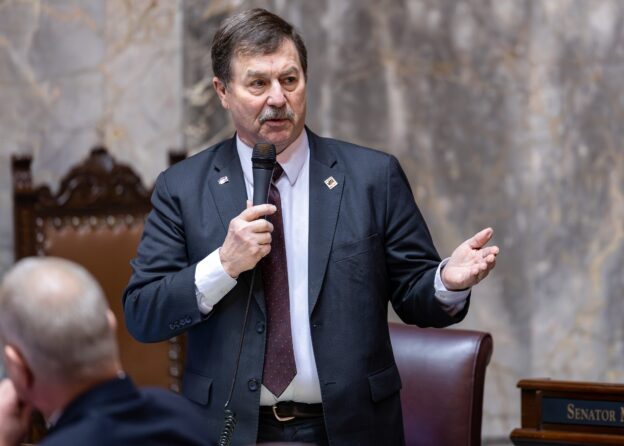
The Senate today voted along party lines to pass its version of the state supplemental operating budget, with opponents arguing it is not sustainable and reduces the percentage of spending that is dedicated to K-12 education.
Sen. Mark Schoesler, R-Ritzville, voted against the budget, which was passed on a 30-19 vote.
“The Senate Democrats’ operating budget relies heavily on one-time money,” said Schoesler, who serves the 9th Legislative District. “It would drain the state’s unrestricted reserves by $2.4 billion, take $750 million from the state’s rainy-day fund, transfer $395 million in capital-gains revenue from the capital budget to the operating budget, and raid $375 million from the Public Works Fund. It’s very risky to rely so much on these transfers and raids.”
Schoesler also opposes the Senate’s operating budget proposal because it makes K-12 education less of a spending priority.
“Under this budget, K-12 education funding would drop to just over a 42% share of the budget, which is lower than at the time when the state Supreme Court’s McCleary ruling was issued in 2012 (43.4%). When Republicans controlled the Senate in 2017, the level of K-12 spending in the operating budget was over 50%. It is a real concern to see K-12’s share of the budget pie become smaller, especially when the state constitution says education is supposed to be the paramount duty of our state.”
Schoesler pointed out that nonpartisan staff on the Senate Ways and Means Committee, which oversees the operating budget, told members there was an estimated gap of $1.5 billion for the current budget cycle and $4.3 billion for the four-year budget outlook ending in 2029.
“Instead of incorporating ideas offered by my Republican colleagues to erase this shortfall through savings and efficiencies, and avoid needless new spending, Senate Democrats instead have created a supplemental operating budget that would increase spending by $2.3 billion, which is 53% more than the $1.5 billion budget gap. At a time when we have a real budget problem, we should not jack up spending so much.”
The Senate Democrats’ supplemental operating budget would result in an 11.3% spending increase for the 2025-27 budget cycle compared to 2023-25. If their budget is enacted, it would result in an $80.1 billion budget, more than double the amount of the 2015-17 budget ($38.2 billion) – which was the last budget created under a Republican-controlled Senate.
Once the House of Representatives approves its supplemental operating budget, key legislators from each chamber will meet to work on a compromise budget for the Senate and House to consider.
The 2026 legislative session ends March 12.

The Senate today unanimously passed its version of the 2025-27 state supplemental capital budget. Republicans who helped develop the spending plan applauded it for addressing needs across Washington.
“Our supplemental budget complements the two-year capital budget enacted by the Legislature last year by spending money in a responsible manner while addressing important needs throughout the entire state,” said 9th District Sen. Mark Schoesler, R-Ritzville, the lead Republican for the Senate capital budget. “Working with our Democrat counterparts, we identified priorities and worked together to create a budget that is both effective and prudent. Our budget does a very good job for several areas, from K-12 and higher education to water infrastructure, housing and flood response.”
Schoesler’s floor speech on the capital budget prior to the Senate’s vote may be viewed here.
“I’m pleased with how this will get the most from the available dollars and make sure priorities are being addressed,” said 16th District Sen. Perry Dozier, R-Waitsburg, who is in his second year on the capital-budget team and has a solid budgeting background from eight years as a Walla Walla County commissioner.
“The conservative approach we took in budgeting a year ago gave us more flexibility when it came to doing good things now. The item I’m happiest about is the funding to deal with the Richland tire pile – it’s also in the House capital budget so I’m feeling positive about getting that cleanup going. Some of the other standouts in what we passed today include the added support for construction projects at small schools around our state, and a long list of water improvements, many of which are on our side of the Cascades. And like last year, I’m grateful to be a part of this team, for the bipartisanship that produced this budget, and the unanimous support it received today.”
The Senate supplemental capital budget (Senate Bill 6003) totals $723 million. It follows up the $7.5 billion 2025-27 state capital budget enacted last year. The new budget addresses a wide range of needs throughout Washington, with funding for projects related to K-12 and higher education, water infrastructure, flood responses, housing and clean energy.
The Senate capital budget provides over $71 million for the Small District and State-Tribal Education Compact Schools (STEC) Modernization Program. The budget also includes $3.7 million for projects for distressed schools, $5 million in new spending for school seismic-safety grants, $1.5 million for Healthy Kids-Healthy Schools to fund grants to support lead remediation and $430,000 for school seismic-safety site class assessments.
Several four-year universities and other higher-education institutions benefit from the capital budget. Several Washington State University projects receive funding:
- Preserving and improving campus facilities.
- Cooling and electrical upgrades to Ensminger Pavilion.
- Spokane Team Health Education Building renovation.
- WSU Creamery lighting and equipment replacement.
Central Washington University receives money for its electrical feeder line to support the growth of campus and geothermal energy. Capital budget funding goes to Eastern Washington University for projects to preserve and improve campus facilities, as well as to Western Washington University for preventative maintenance for building-system repairs and for projects to preserve and improve campus facilities.
In addition, several campuses in the state’s community and technical college system receive funding for projects, including:
- Cascadia College – CC5 Gateway Building.
- Lower Columbia College – David Story Field improvements.
- Spokane Community College – renovation of the east wing of its Main Building.
Schoesler and Dozier, both farmers, noted the Senate capital budget funds agricultural projects, including:
- $10 million for cost-share agreements with dairy-farm owners for anaerobic digester development and maintenance projects.
- $4.6 million for grants to farmers to buy climate-smart agricultural equipment to reduce on-farm carbon emissions and increase carbon sequestration.
- $2.2 million for the design of a new Washington State Department of Agriculture Plant Services Lab at Washington State University’s Prosser campus.
- $400,000 for WSU’s soil health research infrastructure, specifically its long-term agroecological research and extension sites (LTARE).
The Senate supplemental capital budget funds water-infrastructure projects on both sides of the Cascades. Those appropriations include $12.2 million for several water-conservation projects across the state, including:
- Kennewick Irrigation District main canal lining.
- Kittitas Reclamation District South.
- Mill Creek passage, Walla Walla – 3rd to Colville.
- Roza Canal floor replacement.
- Roza Canal sealing project.
- Touchet River mile 42.
- Waynita Creek restoration.
A total of $7.9 million is allocated for many local water-infrastructure projects in both western and eastern Washington, including the Chehalis River irrigation project, Othello water supply, Scatter Creek irrigation and pipeline projects, Skagit District 15 irrigation project and Skookumchuck River irrigation fish screen and water conservation projects.
More than $25 million is provided in the Senate capital budget for response to the December 2025 floods, including:
- $8.6 million for recovery support, including rental assistance and home repair and replacement for individuals recovering from the floods.
- $3.945 million for grants to counties for the removal of debris in rivers and other waterways.
- $2 million for grants to six counties (King, Lewis, Pierce, Skagit, Snohomish and Whatcom) to evaluate the counties’ risks and needs for flood response, preparedness and prevention.
The Senate capital budget provides money for law-enforcement projects, including:
- Over $1 million for Pasco Regional Police Academy improvements.
- $350,000 for the Washington State Criminal Justice Training Commission’s Burien Campus indoor shooting range.
- $252,000 for the Criminal Justice Training Commission’s ADA upgrades at the Burien Campus.
The natural resources section of the Senate’s supplemental capital budget includes:
- $4.2 million for small, family-forest landowners to replace and remove stream-crossing structures, such as culverts, to improve fish passage for salmon, trout and other fish.
- $3.2 million to address tire-pile prevention and cleanup, including removing the Twin Bridges Road tire-pile site near Richland.
- $630,000 for a new welcome center and stormwater drainage improvements at Millersylvania State Park.
The Senate supplemental capital budget spends $150 million for housing and homelessness, with $128.3 million allocated from the Housing Trust Fund for housing projects in both western and eastern Washington.
Once the House of Representatives passes its capital budget, budget writers from the Senate and House are expected to meet as a “conference committee” to develop a compromise budget for both chambers to consider.
The 2026 legislative session is scheduled to end March 12.

With the 2026 legislative session just four weeks away, Sen. Mark Schoesler has filed legislation that aims to make lubricants for vehicles and other machinery more affordable.
Senate Bill 5856 would exempt emissions associated with lubricants from coverage under the state’s “cap-and-tax” policy, formally known as the Climate Commitment Act enacted by legislative Democrats in 2021.
Schoesler, R-Ritzville, said his bill would have Washington join California and Oregon in exempting lubricants, including motor oil, hydraulic fluid, transmission fluid and grease, from surcharges created by each state’s carbon-pricing system.
“California and Oregon don’t impose a carbon-pricing surcharge on vehicle and machinery lubricants but Washington does,” said Schoesler, a member of the Senate Agriculture and Natural Resources Committee. “Removing this surcharge wouldn’t only help our state’s agricultural industry, which can’t pass along these extra costs – it also would improve affordability for Washington drivers whether they have conventional, hybrid or electric vehicles. Changing the oil and other fluids is part of routine maintenance, and the hidden carbon taxes add up.”
Schoesler said SB 5856 would not harm the state’s general fund, considering how much the state is collecting by auctioning carbon credits.
The 2026 legislative session begins Jan. 12 and is scheduled to last 60 days.
Schoesler represents the 9th Legislative District, which covers all or part of Adams, Asotin, Columbia, Garfield, Lincoln, Spokane and Whitman counties.
Two months after the state’s controversial release of the late Kevin Coe, the “South Hill Rapist” who terrorized Spokane before his arrest and conviction in the early 1980s, state Sen. Mark Schoesler has filed a bipartisan bill that would make it harder to release serial rapists.
“Kevin Coe was one of the most dangerous and infamous criminals in our state’s history,” said Schoesler, R-Ritzville. His bill was “prefiled” and will be formally introduced when the 2026 legislative session convenes Jan. 12.
Coe was suspected of violently raping as many as 40 women and girls as young as 14 before being arrested in 1981 and ultimately found guilty of first-degree rape.
“It’s still shocking and unbelievable that the state released him this year,” said Schoesler, who was a college student in Spokane in the late 1970s when Coe was suspected of having committed his rapes. “During his years in confinement, Kevin Coe refused treatment and he never apologized or showed remorse. He should not have been released by the state.”
In early October, the state Department of Social and Health Services released Coe from the Special Commitment Center, on McNeil Island in Puget Sound. Schoesler opposed the move and vowed to introduce legislation in response.
After his release from the SCC, Coe briefly lived in adult-family homes in Federal Way, Auburn and Federal Way again before he died on Dec. 3.
“I hope the Legislature will make it a priority next session to pass this bipartisan bill to prevent or at least make it harder for DSHS or other state agencies to release people guilty of such heinous crimes. We need to place the public’s safety above the freedom of a serial rapist who was unrepentant to the end. After news spread of Coe’s release, several of his victims approached me and told me how angry they were about it,” said Schoesler.
Under the proposal, if a convicted rapist who is confined in the SCC is seeking release from confinement and the state produces sufficient evidence proving the convict refused to participate in sex-offender treatment while in total confinement and has not expressed remorse for the sex offenses of which they were convicted, a release to a less-restrictive alternative placement may not be ordered for the convict.
The proposal has 16 co-sponsors. The leading co-sponsor is Sen. Marcus Riccelli, D-Spokane.
Coe was arrested in March 1981. A jury convicted him later that year on four counts of first-degree rape, resulting in a sentence of life plus 75 years in prison.
In 1984, the state Supreme Court overturned Coe’s four rape convictions partly because three of the four rape victims were hypnotized before identifying Coe as the rapist. In 1985, a second trial was held, this time in Seattle. That jury found Coe guilty of three counts of first-degree rape. In 1988, the state Supreme Court overturned two of the convictions and upheld the third.
In 2006, state Attorney General Rob McKenna filed a petition to have Coe committed as a sexual predator, blocking his scheduled release that year from the Washington State Penitentiary in Walla Walla. Two years later a Spokane County jury declared Coe to be a sexually violent predator. This designation gave the state the right to hold Coe indefinitely at the SCC.
The 2026 legislative session is scheduled to last 60 days.
Schoesler represents the 9th Legislative District, which covers all or part of Adams, Asotin, Garfield, Lincoln, Spokane and Whitman counties.