Tag Archives: Sen. Mark Schoesler

Legislature unanimously approves supplemental capital budget

The Legislature tonight unanimously passed the 2025-27 state supplemental capital budget  following an agreement earlier this week by Senate and House negotiators on a final budget plan.  The Senate voted 49-0 to pass the budget after the House approved it 96-0.

Two eastern Washington Republican senators who helped develop the spending plan applauded it for addressing needs on both sides of the Cascades.

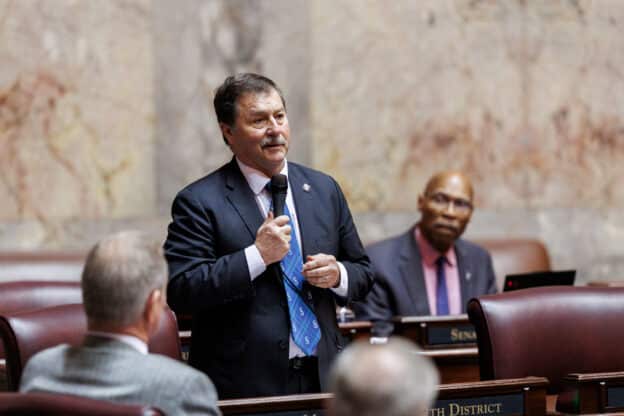
“This capital budget passed by the Legislature is truly a bipartisan package that takes a statewide approach in addressing needs,” said 9th District Sen. Mark Schoesler, R-Ritzville, the lead Republican for the Senate capital budget. “This budget does a very good job for several areas, from K-12 and higher education to water infrastructure, agriculture, housing and flood response.”

“I’m pleased that this budget provides strong funding for water-infrastructure projects on both sides of Washington. The House capital budget had no water projects, so it’s good that we preserved the water projects that were in the Senate capital budget. The final capital budget also funds many small-school modernization projects throughout our state. During negotiations with the House, we insisted on these small-school projects in the budget,” added Schoesler, who commended the Senate capital budget team on developing a solid and prudent budget, especially his Democratic counterpart, Sen. Yasmin Trudeau, D-Tacoma.

“This budget is an example of making a good thing better. It builds on the very solid capital budget approved in 2025 by accommodating the unforeseen needs that we knew would emerge in the months since then,” said 16th District Sen. Perry Dozier, who is in his second year as assistant Republican leader on the capital budget. “As our bipartisan Senate team negotiated this final version with the House, we held firm to our positions on critical areas like water infrastructure and support for small school districts – and to me that had a lot to do with the unanimous vote in the Senate today.

“Although people understandably think of construction when it comes to the capital budget, the natural-resources part is also important. That’s where the water projects come in, and this year I’m very pleased that the House agreed with allocating $3.2 million toward the problem of waste tires. Being able to respond to community needs like dealing with that massive tire pile outside Richland is why working on this budget is one of the most uplifting things I get to do as a lawmaker,” added Dozier, R-Waitsburg.

The supplemental capital budget (Senate Bill 6003) totals $889 million. It follows up the $7.5 billion 2025-27 state capital budget enacted last year. The new budget addresses a wide range of needs throughout Washington, with funding for projects related to K-12 and higher education, water infrastructure, flood responses, housing and clean energy.

The revised capital budget provides over $71 million for the Small District and State-Tribal Education Compact (STEC) Schools Modernization Program. The budget also includes:

  • $21.2 million for the school construction assistance program (SCAP).
  • $13.9 million in new spending for school seismic safety grants.
  • $5.4 million for projects for distressed schools.
  • $3.78 million for a SCAP enhancement program pilot project.
  • $2.5 million for Healthy Kids-Healthy Schools to fund grants to support lead remediation.
  • $430,000 for school seismic-safety site class assessments.

Four-year universities and other higher-education institutions benefit from the capital budget. Several Washington State University projects receive funding:

  • Preserving and improving campus facilities ($6 million).
  • Cooling and electrical upgrades to Ensminger Pavilion ($1.5 million).
  • Spokane Team Health Education Building renovation ($7 million).
  • WSU Creamery lighting and equipment replacement ($1 million).
  • Virtual fencing grants to enhance climate resiliency ($500,000).

Central Washington University receives money for its electrical feeder line to support the growth of campus and geothermal energy. Capital budget funding goes to Eastern Washington University for projects to preserve and improve campus facilities, as well as to Western Washington University for preventative maintenance for building-system repairs and for projects to preserve and improve campus facilities.

In addition, several campuses in the state’s community and technical college system receive funding for projects, including:

  • Cascadia College – CC5 Gateway Building.
  • Lower Columbia College – David Story Field improvements.
  • Spokane Community College – renovation of the east wing of its Main Building.

Schoesler and Dozier, both farmers, noted the updated capital budget funds agricultural projects, including:

  • $10 million for cost-share agreements with dairy-farm owners for anaerobic digester development and maintenance projects.
  • $4.6 million for grants to farmers to buy climate-smart agricultural equipment to reduce on-farm carbon emissions and increase carbon sequestration.
  • $2.2 million for the design of a new Washington State Department of Agriculture Plant Services Lab at Washington State University’s Prosser campus.
  • $400,000 for WSU’s soil health research infrastructure, specifically its long-term agroecological research and extension sites (LTARE).

The supplemental capital budget funds water-infrastructure projects on both sides of the Cascades. Those appropriations include $8.977 million for several water-conservation projects across the state, including:

  • Kennewick Irrigation District main canal lining.
  • Kittitas Reclamation District South.
  • Mill Creek passage, Walla Walla – 3rd to Colville.
  • Roza Canal floor replacement.
  • Roza Canal sealing project.
  • Touchet River mile 42.
  • Waynita Creek restoration.
  • Water system efficiency leak detection and repairs.

About $16.1 million is allocated for many local water-infrastructure projects in both western and eastern Washington, including the Chehalis River irrigation project, Othello water supply, Scatter Creek irrigation and pipeline projects, Skagit District 15 irrigation project and Skookumchuck River irrigation fish screen and water conservation projects.

The supplemental capital budget provides funding for disaster and response to the December 2025 floods, including:

  • $3.1 million for grants to counties for the removal of debris in rivers and other waterways.
  • $2 million for grants to six counties (King, Lewis, Pierce, Skagit, Snohomish and Whatcom) to evaluate the counties’ risks and needs for flood response, preparedness and prevention.

The capital budget provides money for law-enforcement projects, including:

  • Over $1 million for Pasco Regional Police Academy improvements.
  • $350,000 for the Washington State Criminal Justice Training Commission’s Burien Campus indoor shooting range.
  • $252,000 for the Criminal Justice Training Commission’s ADA upgrades at the Burien Campus.

The natural resources section of the updated capital budget includes:

  • $3.5 million for small, family-forest landowners to replace and remove stream-crossing structures, such as culverts, to improve fish passage for salmon, trout and other fish.
  • $3.2 million to address tire-pile prevention and cleanup, including removing the Twin Bridges Road tire-pile site near Richland.
  • $630,000 for a new welcome center and stormwater drainage improvements at Millersylvania State Park.

The supplemental capital budget spends $200 million for housing and homelessness, with $123.3 million allocated from the Housing Trust Fund for housing projects in both western and eastern Washington.

Over $30 million in funding is provided for about 120 new local and community projects.

The 2026 legislative session is scheduled to end tonight.


Schoesler opposes Senate passage of supplemental operating budget

The Senate today voted along party lines to pass its version of the state supplemental operating budget, with opponents arguing it is not sustainable and reduces the percentage of spending that is dedicated to K-12 education.

Sen. Mark Schoesler, R-Ritzville, voted against the budget, which was passed on a 30-19 vote.

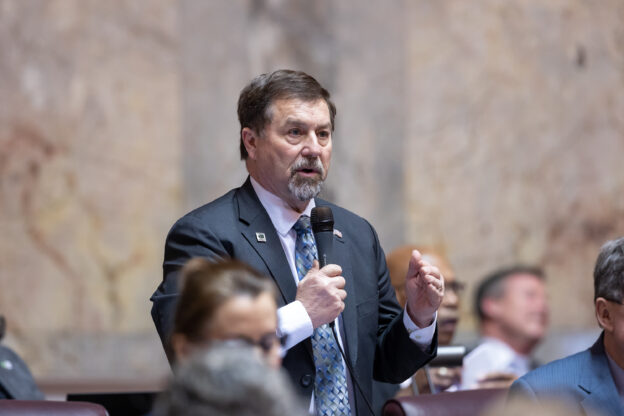
“The Senate Democrats’ operating budget relies heavily on one-time money,” said Schoesler, who serves the 9th Legislative District. “It would drain the state’s unrestricted reserves by $2.4 billion, take $750 million from the state’s rainy-day fund, transfer $395 million in capital-gains revenue from the capital budget to the operating budget, and raid $375 million from the Public Works Fund. It’s very risky to rely so much on these transfers and raids.”

Schoesler also opposes the Senate’s operating budget proposal because it makes K-12 education less of a spending priority.

“Under this budget, K-12 education funding would drop to just over a 42% share of the budget, which is lower than at the time when the state Supreme Court’s McCleary ruling was issued in 2012 (43.4%). When Republicans controlled the Senate in 2017, the level of K-12 spending in the operating budget was over 50%. It is a real concern to see K-12’s share of the budget pie become smaller, especially when the state constitution says education is supposed to be the paramount duty of our state.”

Schoesler pointed out that nonpartisan staff on the Senate Ways and Means Committee, which oversees the operating budget, told members there was an estimated gap of $1.5 billion for the current budget cycle and $4.3 billion for the four-year budget outlook ending in 2029.

“Instead of incorporating ideas offered by my Republican colleagues to erase this shortfall through savings and efficiencies, and avoid needless new spending, Senate Democrats instead have created a supplemental operating budget that would increase spending by $2.3 billion, which is 53% more than the $1.5 billion budget gap. At a time when we have a real budget problem, we should not jack up spending so much.”

The Senate Democrats’ supplemental operating budget would result in an 11.3% spending increase for the 2025-27 budget cycle compared to 2023-25. If their budget is enacted, it would result in an $80.1 billion budget, more than double the amount of the 2015-17 budget ($38.2 billion) – which was the last budget created under a Republican-controlled Senate.

Once the House of Representatives approves its supplemental operating budget, key legislators from each chamber will meet to work on a compromise budget for the Senate and House to consider.

The 2026 legislative session ends March 12.

Senate unanimously approves supplemental capital budget

The Senate today unanimously passed its version of the 2025-27 state supplemental capital budget. Republicans who helped develop the spending plan applauded it for addressing needs across Washington.

“Our supplemental budget complements the two-year capital budget enacted by the Legislature last year by spending money in a responsible manner while addressing important needs throughout the entire state,” said 9th District Sen. Mark Schoesler, R-Ritzville, the lead Republican for the Senate capital budget. “Working with our Democrat counterparts, we identified priorities and worked together to create a budget that is both effective and prudent. Our budget does a very good job for several areas, from K-12 and higher education to water infrastructure, housing and flood response.”

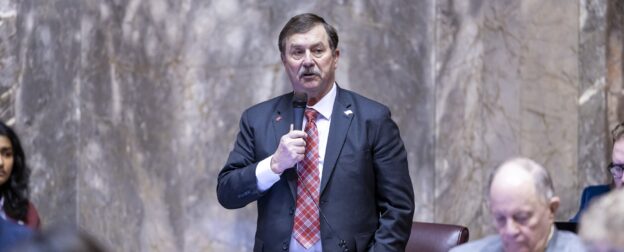
Schoesler’s floor speech on the capital budget prior to the Senate’s vote may be viewed here.

“I’m pleased with how this will get the most from the available dollars and make sure priorities are being addressed,” said 16th District Sen. Perry Dozier, R-Waitsburg, who is in his second year on the capital-budget team and has a solid budgeting background from eight years as a Walla Walla County commissioner.

“The conservative approach we took in budgeting a year ago gave us more flexibility when it came to doing good things now. The item I’m happiest about is the funding to deal with the Richland tire pile – it’s also in the House capital budget so I’m feeling positive about getting that cleanup going. Some of the other standouts in what we passed today include the added support for construction projects at small schools around our state, and a long list of water improvements, many of which are on our side of the Cascades. And like last year, I’m grateful to be a part of this team, for the bipartisanship that produced this budget, and the unanimous support it received today.”

The Senate supplemental capital budget (Senate Bill 6003) totals $723 million. It follows up the $7.5 billion 2025-27 state capital budget enacted last year. The new budget addresses a wide range of needs throughout Washington, with funding for projects related to K-12 and higher education, water infrastructure, flood responses, housing and clean energy.

The Senate capital budget provides over $71 million for the Small District and State-Tribal Education Compact Schools (STEC) Modernization Program. The budget also includes $3.7 million for projects for distressed schools, $5 million in new spending for school seismic-safety grants, $1.5 million for Healthy Kids-Healthy Schools to fund grants to support lead remediation and $430,000 for school seismic-safety site class assessments.

Several four-year universities and other higher-education institutions benefit from the capital budget. Several Washington State University projects receive funding:

  • Preserving and improving campus facilities.
  • Cooling and electrical upgrades to Ensminger Pavilion.
  • Spokane Team Health Education Building renovation.
  • WSU Creamery lighting and equipment replacement.

Central Washington University receives money for its electrical feeder line to support the growth of campus and geothermal energy. Capital budget funding goes to Eastern Washington University for projects to preserve and improve campus facilities, as well as to Western Washington University for preventative maintenance for building-system repairs and for projects to preserve and improve campus facilities.

In addition, several campuses in the state’s community and technical college system receive funding for projects, including:

  • Cascadia College – CC5 Gateway Building.
  • Lower Columbia College – David Story Field improvements.
  • Spokane Community College – renovation of the east wing of its Main Building.

Schoesler and Dozier, both farmers, noted the Senate capital budget funds agricultural projects, including:

  • $10 million for cost-share agreements with dairy-farm owners for anaerobic digester development and maintenance projects.
  • $4.6 million for grants to farmers to buy climate-smart agricultural equipment to reduce on-farm carbon emissions and increase carbon sequestration.
  • $2.2 million for the design of a new Washington State Department of Agriculture Plant Services Lab at Washington State University’s Prosser campus.
  • $400,000 for WSU’s soil health research infrastructure, specifically its long-term agroecological research and extension sites (LTARE).

The Senate supplemental capital budget funds water-infrastructure projects on both sides of the Cascades. Those appropriations include $12.2 million for several water-conservation projects across the state, including:

  • Kennewick Irrigation District main canal lining.
  • Kittitas Reclamation District South.
  • Mill Creek passage, Walla Walla – 3rd to Colville.
  • Roza Canal floor replacement.
  • Roza Canal sealing project.
  • Touchet River mile 42.
  • Waynita Creek restoration.

A total of $7.9 million is allocated for many local water-infrastructure projects in both western and eastern Washington, including the Chehalis River irrigation project, Othello water supply, Scatter Creek irrigation and pipeline projects, Skagit District 15 irrigation project and Skookumchuck River irrigation fish screen and water conservation projects.

More than $25 million is provided in the Senate capital budget for response to the December 2025 floods, including:

  • $8.6 million for recovery support, including rental assistance and home repair and replacement for individuals recovering from the floods.
  • $3.945 million for grants to counties for the removal of debris in rivers and other waterways.
  • $2 million for grants to six counties (King, Lewis, Pierce, Skagit, Snohomish and Whatcom) to evaluate the counties’ risks and needs for flood response, preparedness and prevention.

The Senate capital budget provides money for law-enforcement projects, including:

  • Over $1 million for Pasco Regional Police Academy improvements.
  • $350,000 for the Washington State Criminal Justice Training Commission’s Burien Campus indoor shooting range.
  • $252,000 for the Criminal Justice Training Commission’s ADA upgrades at the Burien Campus.

The natural resources section of the Senate’s supplemental capital budget includes:

  • $4.2 million for small, family-forest landowners to replace and remove stream-crossing structures, such as culverts, to improve fish passage for salmon, trout and other fish.
  • $3.2 million to address tire-pile prevention and cleanup, including removing the Twin Bridges Road tire-pile site near Richland.
  • $630,000 for a new welcome center and stormwater drainage improvements at Millersylvania State Park.

The Senate supplemental capital budget spends $150 million for housing and homelessness, with $128.3 million allocated from the Housing Trust Fund for housing projects in both western and eastern Washington.

Once the House of Representatives passes its capital budget, budget writers from the Senate and House are expected to meet as a “conference committee” to develop a compromise budget for both chambers to consider.

The 2026 legislative session is scheduled to end March 12.

Schoesler blasts Democrats’ passage of income-tax bill in Senate

Democrats controlling the Senate voted 27-22 today to create a state income tax in Washington, despite voters having rejected such a tax numerous times over the past century.

Senate Bill 6346 would impose a 9.9% tax on individual income over $1 million.

9th District Sen. Mark Schoesler, along with all 18 other Republicans and three Democrats, voted against the proposal. He argued it is a first step toward a state income tax on all Washingtonians.

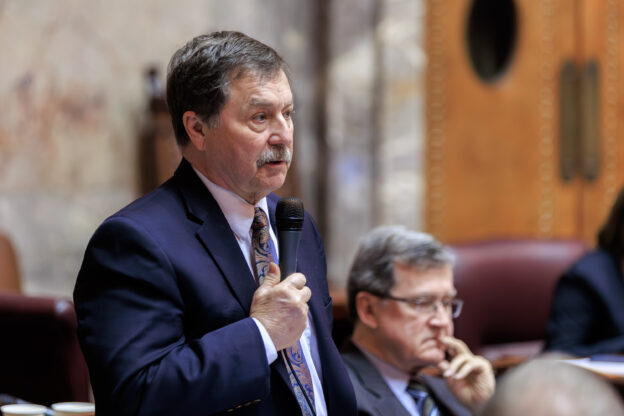
“The bill’s proponents say it would only tax people making more than a million dollars a year, but you can almost guarantee Democrats will come back and lower the income-tax threshold once the people initially paying this new income tax take their money and move out of Washington,” said Schoesler, R-Ritzville. “Once that happens, people making much less than a million will have to pay this income tax as well. History tells us everyone eventually will have to pay this state income tax, not just millionaires.”

During his floor speech opposing SB 6346, Schoesler told senators how the Legislature in previous years has created or raised taxes with promises to sufficiently fund K-12 education or health care.

“People out there actually are being told if you pass this income tax, you’re going to get health care funded and you’re going to get education funded. Nowhere in this bill does any section dedicate one penny to those causes that many people are very, very supportive of. It just isn’t there. We were told years ago that if we just had some more ‘sin’ taxes, we could fund health care, which I think is called the Basic Health Plan. Well, that didn’t work either because of an insatiable appetite for tax money that doesn’t go where people say it’s going to go,” said Schoesler.

“This bill doesn’t even say that the money raised by this income tax would be spent just on K-12. Instead, it would just go into the state general fund’s giant pot of money that can be spent on pretty much anything.”

If enacted, SB 6346 would override Initiative 2111, the measure approved by the Legislature with bipartisan support in 2024 that banned state and local income taxes in Washington.

“Nearly 450,000 voters in our state signed I-2111, sending it to the Legislature. But now the Democrats are ignoring the voters’ wishes – yet again. It’s important to remember that Washington voters have rejected an income-tax proposal 11 times! Democrats just thumbed their noses at voters and ignored the will of the people. They even included a provision in this bill that makes it impossible for voters to challenge it at the ballot box.”

The 9th District senator also noted SB 6346 would hit married people filing jointly who make a combined income of $1 million the same way it hits individuals.

“This proposal will punish marriage,” said Schoesler.

Majority Democrats defeated many Republican amendments to the proposal, including:

  • Allowing people the right to vote via referendum on the state income-tax bill.
  • Specifying that the bill is unconstitutional because it violates well-established state constitutional limitations on property taxes.
  • Removing the marriage penalty provision from the bill.
  • Providing a sales-and-use tax exemption for diapers.

SB 6346 now goes to the House of Representatives for further consideration.

Senate passes Schoesler bill encouraging voluntary incentives related to wildfire mitigation

The Senate yesterday unanimously approved Senate Bill 5919, a measure introduced by 9th District Sen. Mark Schoesler that would encourage fire districts and insurance providers to collaborate and develop voluntary incentives to promote wildfire-mitigation best practices related to agricultural activities.

Schoesler, R-Ritzville, says SB 5919 aims to encourage incentives much as auto-insurance companies provide discounts for students with good grades

“In recent years, two of our small farming communities were nearly lost to wildfires from wheat fields,” Schoesler told senators during his floor speech supporting the proposal. “Because of farmers and others who volunteered their equipment, water and other things, we saved those two small towns. We have tools we could use, taking advantage of red-flag days and incentives to not work on those days, and this gives us a chance to develop voluntary incentives for producers that they could get a discount on their crop fire insurance or for their rural residences by voluntary incentives with their fire districts. And the carriers may offer the incentives. We have incentives for other areas. We could have more if we just do it voluntarily.”

When SB 5919 received a public hearing in the Senate Business, Trade and Economic Development Committee last month, Michael Harris of Franklin County Fire Protection District #3 testified in favor of it.

SB 5919 now goes to the House of Representatives for further consideration.

Senate adopts resolution honoring 2025 Seattle Mariners and Cal Raleigh

The Senate today paused for a moment from considering bills to honor one of the state’s most beloved sports teams.

The Senate adopted a resolution celebrating the 2025 Seattle Mariners’ historic season and Mariners catcher Cal Raleigh. The resolution, sponsored by 9th District Sen. Mark Schoesler, R-Ritzville, may be seen here.

“The 2025 Mariners provided us with such a great season and so many exciting moments,” said Schoesler. “I think I speak for everyone here and around our state when I say how proud we are of the M’s. They came so close to finally reaching the World Series and we’re hopeful they will finally make it there in 2026. They are the kind of team that you want to root for.

“For years to come, we’ll remember the names of Cal Raleigh, Julio Rodriguez, J.P. Crawford, Josh Naylor, Jorge Polanco, Geno Suárez , Randy Arozarena, Bryan Woo, Logan Gilbert, George Kirby, Andrés Muñoz and others. Thanks for a great season and for all of the wonderful memories,” added Schoesler.

Several Mariners officials visited the Senate chamber for the resolution, including President of Baseball Operations Jerry Dipoto, Vice President and Assistant General Manager Justin Hollander, Manager Dan Wilson, Vice President of Communications Tim Hevly and Rick Rizzs, the team’s iconic lead radio broadcaster who recently announced he will retire at the end of the 2026 season.

Here is the text of the resolution:

SENATE RESOLUTION 8676

By Senators Schoesler, Boehnke, Chapman, Christian, MacEwen, Nobles, Pedersen, Riccelli, Robinson, Shewmake, Warnick, C. Wilson, Dozier, Goehner, Hasegawa, Krishnadasan, Lovelett, Lovick, Orwall, Saldaña, Short, Slatter, Valdez, Holy, Trudeau, and Wellman

WHEREAS, The Seattle Mariners entered the 2025 Major League Baseball season with four American League West Division titles and five playoff appearances since the franchise began in 1977; and

WHEREAS, The Mariners lost two starting position players early in the 2025 season, right fielder Victor Robles and second baseman Ryan Bliss, with only Robles returning five months later; and

WHEREAS, Starting pitchers Logan Gilbert, George Kirby, and Bryce Miller missed many starts during the season due to injuries; and

WHEREAS, The absence of these talented players contributed to the Mariners having a 73-68 record as of September 5th and trailing the defending American League West Division champion Houston Astros by 3.5 games in the AL West standings; and

WHEREAS, The Mariners then went on a 10-game winning streak and won 17 of 18 games to finish the regular season with a 90-72 record and win the division title by three games; and

WHEREAS, Catcher Cal Raleigh finished the season with 60 home runs, 125 runs batted in, 110 runs scored, a .247 batting average and a .589 slugging percentage, as well as stellar defensive play to lead the Mariners to their first division title in 24 years; and

WHEREAS, The Mariners defeated the Detroit Tigers in an American League Divisional Series three games to two, capped by a 3-2 victory in 15 innings that ended on Jorge Polanco’s bases loaded single that scored J.P. Crawford with the winning run before a sold-out and frantic T-Mobile Park crowd; and

WHEREAS, The Mariners and the Toronto Blue Jays split the first four games of the American League Championship Series; and

WHEREAS, Seattle trailed Toronto 2-1 entering the eighth inning of Game 5 at T-Mobile Park until Cal Raleigh hit a solo home run to tie the game, followed by a grand slam home run by third baseman Eugenio Suárez that gave the Mariners a thrilling 6-2 win and a 3-2 lead in the playoff series; and

WHEREAS, After their opponents tied the series again the Mariners fought valiantly but lost 4-3 in the deciding Game 7 to barely miss going to the World Series for the first time in the team’s history; and

WHEREAS, Former longtime Mariners catcher Dan Wilson, a member of every Mariners team to reach the playoffs, led the team to a division title in his first full season as the Mariners manager, and finished third in voting for the 2025 American League Manager of the Year Award; and

WHEREAS, Cal Raleigh, despite setting the MLB record for home runs by a catcher in a season, shattering Mickey Mantle’s record for home runs by a switch hitter, setting a new Mariners home run record, and playing the most physically demanding position on the baseball field, was robbed by national baseball writers when they did not choose him as the American League Most Valuable Player; and

WHEREAS, Cal Raleigh and Mariners center fielder Julio Rodríguez were named to the all-MLB first team and Mariners starting pitcher Bryan Woo and closer Andrés Muñoz were named to the second team; and

WHEREAS, Mariners President of Baseball Operations Jerry Dipoto was named Baseball America Executive of the Year in December; and

WHEREAS, The Mariners will celebrate their 50th anniversary season in 2026;

NOW, THEREFORE, BE IT RESOLVED, That the Washington State Senate congratulate the 2025 Seattle Mariners on winning the American League West Division and coming so close to finally reaching the World Series, and congratulate Cal Raleigh on his historic Mariners Nation MVP season.

(CAPTION: Mariners Manager Dan Wilson (left) and team broadcaster Rick Rizzs (right) sit on the Senate rostrum while Senate Resolution 8676 is adopted on the Senate floor.)