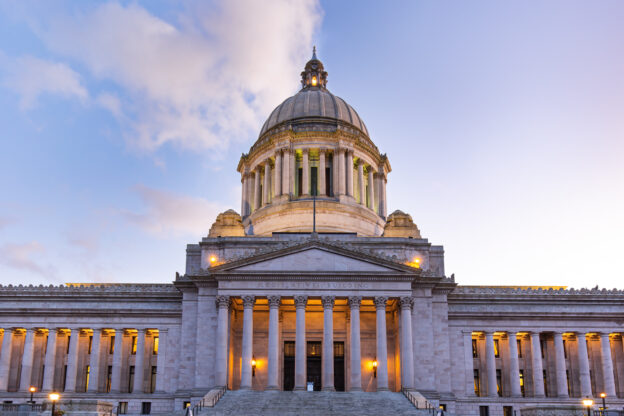
The Senate today unanimously passed its version of the 2025-27 state supplemental capital budget. Republicans who helped develop the spending plan applauded it for addressing needs across Washington.
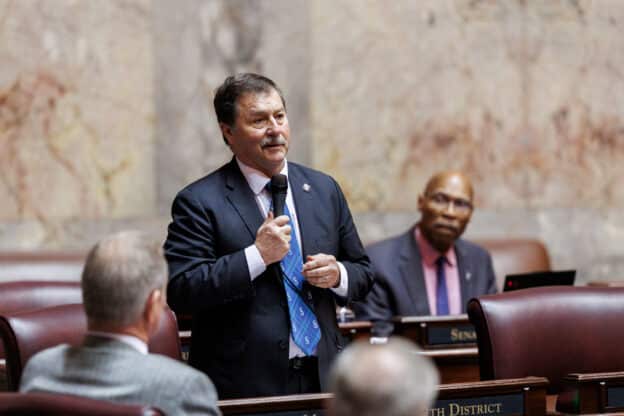
“Our supplemental budget complements the two-year capital budget enacted by the Legislature last year by spending money in a responsible manner while addressing important needs throughout the entire state,” said 9th District Sen. Mark Schoesler, R-Ritzville, the lead Republican for the Senate capital budget. “Working with our Democrat counterparts, we identified priorities and worked together to create a budget that is both effective and prudent. Our budget does a very good job for several areas, from K-12 and higher education to water infrastructure, housing and flood response.”
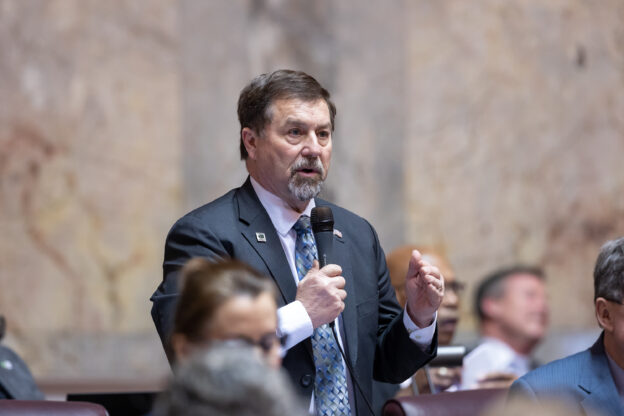
Schoesler’s floor speech on the capital budget prior to the Senate’s vote may be viewed here.
“I’m pleased with how this will get the most from the available dollars and make sure priorities are being addressed,” said 16th District Sen. Perry Dozier, R-Waitsburg, who is in his second year on the capital-budget team and has a solid budgeting background from eight years as a Walla Walla County commissioner.
“The conservative approach we took in budgeting a year ago gave us more flexibility when it came to doing good things now. The item I’m happiest about is the funding to deal with the Richland tire pile – it’s also in the House capital budget so I’m feeling positive about getting that cleanup going. Some of the other standouts in what we passed today include the added support for construction projects at small schools around our state, and a long list of water improvements, many of which are on our side of the Cascades. And like last year, I’m grateful to be a part of this team, for the bipartisanship that produced this budget, and the unanimous support it received today.”
The Senate supplemental capital budget (Senate Bill 6003) totals $723 million. It follows up the $7.5 billion 2025-27 state capital budget enacted last year. The new budget addresses a wide range of needs throughout Washington, with funding for projects related to K-12 and higher education, water infrastructure, flood responses, housing and clean energy.
The Senate capital budget provides over $71 million for the Small District and State-Tribal Education Compact Schools (STEC) Modernization Program. The budget also includes $3.7 million for projects for distressed schools, $5 million in new spending for school seismic-safety grants, $1.5 million for Healthy Kids-Healthy Schools to fund grants to support lead remediation and $430,000 for school seismic-safety site class assessments.
Several four-year universities and other higher-education institutions benefit from the capital budget. Several Washington State University projects receive funding:
- Preserving and improving campus facilities.
- Cooling and electrical upgrades to Ensminger Pavilion.
- Spokane Team Health Education Building renovation.
- WSU Creamery lighting and equipment replacement.
Central Washington University receives money for its electrical feeder line to support the growth of campus and geothermal energy. Capital budget funding goes to Eastern Washington University for projects to preserve and improve campus facilities, as well as to Western Washington University for preventative maintenance for building-system repairs and for projects to preserve and improve campus facilities.
In addition, several campuses in the state’s community and technical college system receive funding for projects, including:
- Cascadia College – CC5 Gateway Building.
- Lower Columbia College – David Story Field improvements.
- Spokane Community College – renovation of the east wing of its Main Building.
Schoesler and Dozier, both farmers, noted the Senate capital budget funds agricultural projects, including:
- $10 million for cost-share agreements with dairy-farm owners for anaerobic digester development and maintenance projects.
- $4.6 million for grants to farmers to buy climate-smart agricultural equipment to reduce on-farm carbon emissions and increase carbon sequestration.
- $2.2 million for the design of a new Washington State Department of Agriculture Plant Services Lab at Washington State University’s Prosser campus.
- $400,000 for WSU’s soil health research infrastructure, specifically its long-term agroecological research and extension sites (LTARE).
The Senate supplemental capital budget funds water-infrastructure projects on both sides of the Cascades. Those appropriations include $12.2 million for several water-conservation projects across the state, including:
- Kennewick Irrigation District main canal lining.
- Kittitas Reclamation District South.
- Mill Creek passage, Walla Walla – 3rd to Colville.
- Roza Canal floor replacement.
- Roza Canal sealing project.
- Touchet River mile 42.
- Waynita Creek restoration.
A total of $7.9 million is allocated for many local water-infrastructure projects in both western and eastern Washington, including the Chehalis River irrigation project, Othello water supply, Scatter Creek irrigation and pipeline projects, Skagit District 15 irrigation project and Skookumchuck River irrigation fish screen and water conservation projects.
More than $25 million is provided in the Senate capital budget for response to the December 2025 floods, including:
- $8.6 million for recovery support, including rental assistance and home repair and replacement for individuals recovering from the floods.
- $3.945 million for grants to counties for the removal of debris in rivers and other waterways.
- $2 million for grants to six counties (King, Lewis, Pierce, Skagit, Snohomish and Whatcom) to evaluate the counties’ risks and needs for flood response, preparedness and prevention.
The Senate capital budget provides money for law-enforcement projects, including:
- Over $1 million for Pasco Regional Police Academy improvements.
- $350,000 for the Washington State Criminal Justice Training Commission’s Burien Campus indoor shooting range.
- $252,000 for the Criminal Justice Training Commission’s ADA upgrades at the Burien Campus.
The natural resources section of the Senate’s supplemental capital budget includes:
- $4.2 million for small, family-forest landowners to replace and remove stream-crossing structures, such as culverts, to improve fish passage for salmon, trout and other fish.
- $3.2 million to address tire-pile prevention and cleanup, including removing the Twin Bridges Road tire-pile site near Richland.
- $630,000 for a new welcome center and stormwater drainage improvements at Millersylvania State Park.
The Senate supplemental capital budget spends $150 million for housing and homelessness, with $128.3 million allocated from the Housing Trust Fund for housing projects in both western and eastern Washington.
Once the House of Representatives passes its capital budget, budget writers from the Senate and House are expected to meet as a “conference committee” to develop a compromise budget for both chambers to consider.
The 2026 legislative session is scheduled to end March 12.